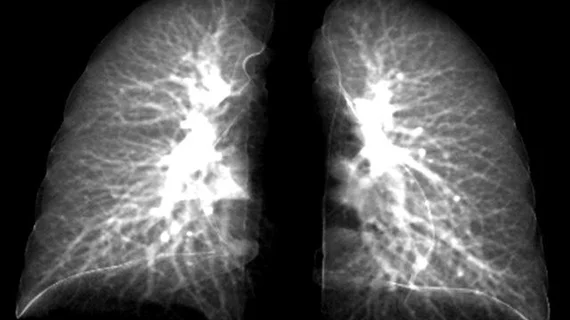
“In patients with lung cancer, DECT has further potential to quantify postsurgical global and regional changes in lung volume and perfusion,” authors of a new paper in AJR suggested.
Many AI devices have already been integrated into clinical practice, but a new analysis questions whether certain validation processes could lead to algorithm biases.
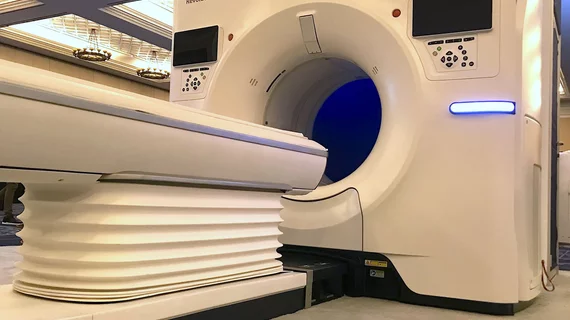
A GE Revolution CT system on display at the 2022 Society of Cardiovascular Computed Tomography (SCCT) meeting is an example of the types of systems being sought in the U.S. and Western Europe replacement CT market. It features AI enhanced features to automate protocol and help reduce dose, has160 mm of anatomical coverage per rotation and offers spectral imaging using fast kV switching between different energies during one scan.
Leading up to the 2022 RSNA meeting, Signify Research shares the trends and new innovations in CT scanner technology it has seen in recent years.
A new report suggests there may soon be a shortage of molybdenum-99 (Mo-99)/technetium-99m (Tc-99m). What does that mean for patient care in the months ahead?
The preliminary results of a new study published in the medRxiv preprint server highlight variances in fetal brain development based on mothers’ perceived stress during the onset of COVID.
The FDA tracks mammography systems and the number of exams performed in the U.S. through its Mammography Quality Standards Act (MQSA) program.
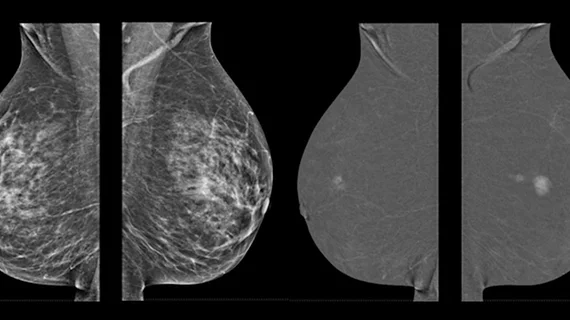
A new paper highlights several studies supporting the use of screening mammography for women with breast implants, as well as additional considerations that need to be made for these patients.