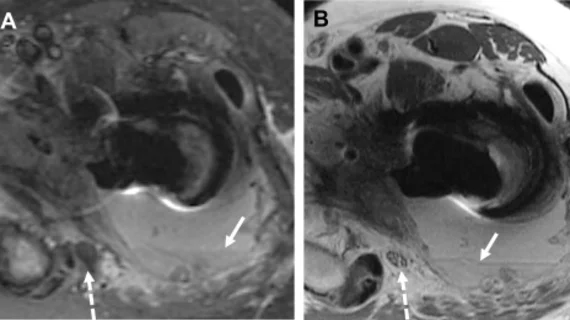
74-year-old female one day post revision left THA. Axial proton density (PD) (A) and inversion recovery (B) images demonstrate the sciatic nerve (dashed arrow) coursing posteromedial to a large hematoma (note hematocrit level (solid arrow)). Caption and image courtesy of the European Journal of Radiology.
A new paper in the European Journal of Radiology offers an updated overview of common MRI findings in patients who develop foot drop following total hip arthroplasty.
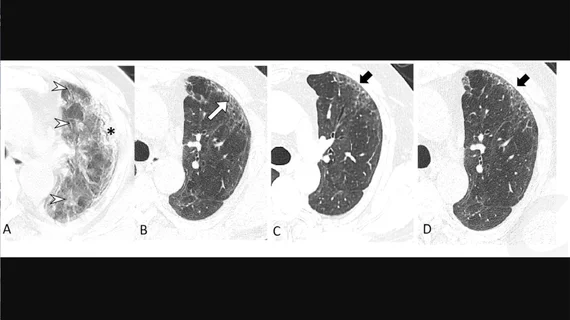
Serial transverse CT scans in a 65-year-old man with severe COVID-19 from 23-days after infection to 2-year follow up. The newest followup images on the right showed presence of subtle, subpleural honeycombing at the same area (black arrows). Image courtesy of Radiology.
Scans on these patients show a combination of fibrosis, thickening, honeycombing, cystic changes and dilation of the bronchi, among other imaging features.
A Feb. 14 announcement from Bracco indicates that the recently FDA-approved, gadolinium-based contrast agent VUEWAY, also known as gadopiclenol, is officially being used for patients undergoing MR imaging.
Once the go-to exam for gaining intra-articular details of major joints, MR arthrography appears to be wavering in popularity, decreasing 'drastically' at some institutions.
While the ACC/AHA 2021 Chest Pain Assessment Guidelines included cardiac CT angiography as a top level recommendation, gaps in evidence still need to be filled.
Recent developments in NLP technology have improved its ability to recognize semantics and context, making it more likely that NLP could generate coherent medical reports without radiologist assistance.
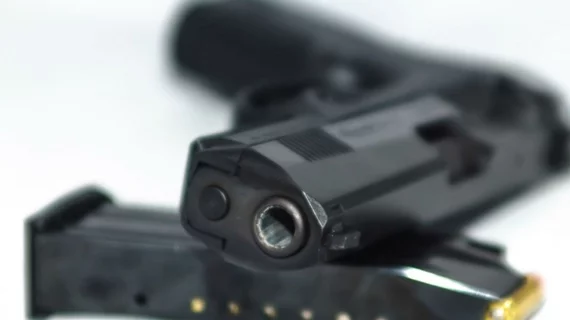
On Jan. 16, lawyer Leandro Mathias de Novaes was wearing a registered firearm on his waistband while assisting his mother in the MRI suite when the scanner’s powerful magnet pulled the gun away from his body.