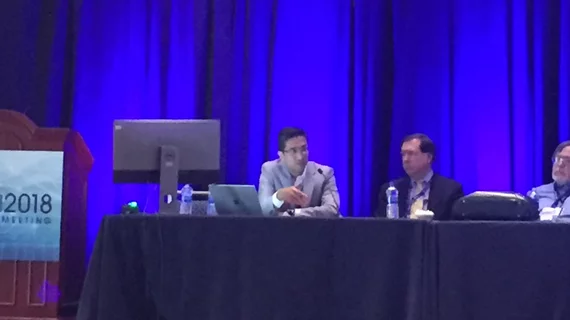
The Society for Imaging Informatics in Medicine’s 2018 annual meeting wrapped up with a keynote address from Curt Langlotz, MD, PhD, with Stanford University, on the rise of artificial intelligence (AI).
A police investigation is ongoing after officials found a computer and external hard drive used to store retinal images were stolen from the John A. Moran Eye Center at the University of Utah.
A woman in New York is being sued for $1 million after posting a negative review online about a NYU Langone Health gynecologist, according to a recent report by CBS2, New York.
The FDA has proposed reclassifying medical image analyzers used in mammography for breast cancer, ultrasound for breast lesions, x-ray for lung nodules and x-ray for dental caries as class II medical devices instead of class III.
Social media has helped connect teleradiologists from around the world with the few physicians and imaging providers practicing in war-torn Syria, according to a study published May 31 in the Journal of the American College of Radiology.
A professor of radiology at Johns Hopkins Medicine in Baltimore and computer science students are developing a tumor-detecting AI algorithm that can be built into computed tomography (CT) scanner software to recognize and differentiate between a normal pancreas and one that's cancerous.
TeraRecon today announced that its first-of-kind Northstar™ AI Explorer has reached a new milestone that allows physicians to interact with individual measurements, markings, and findings created by artificial intelligence (AI) image processing algorithms.
A group of panelists at the Society for Imaging Informatics in Medicine (SIIM)'s annual meeting say radiology and pathology must partner to advance both specialties, with a Google-like capability for clinicians as one possible goal.
Continued investments around highly scalable InteleOne® platform allow Assignment Engine, Order Management and Diagnostic Workflows solutions to come together as one.
Health Imaging spoke with Anjali Malik, MD, a breast radiologist from Washington Radiology in the Washington, D.C. metro area about how the ACS's updated colon cancer screening guideline will impact diagnostic imaging and patient care.