Leaders from the Medical Imaging and Technology Alliance (MITA) expressed concern regarding a Senate Finance Committee hearing held on June 20 with the U.S. Department of Commerce Sec. Wilbur Ross that considered current and proposed tariffs on Chinese imported goods.
China and Israel are global leaders in artificial intelligence (AI) image analysis technology because of government support and industry collaboration, according to a recent Forbes article.
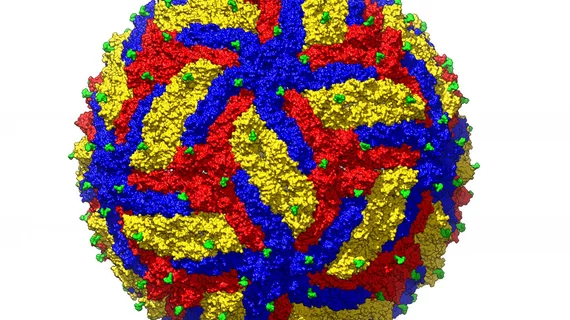
The 3D Zika image shows glycoproteins (blue, yellow and red) and glycan in green, which could help determine the symptoms of the virus. Photo courtesy of Sevvana et al.
Researchers have captured the highest-resolution image to date of the Zika virus, which caused a global health crisis in 2015, and left thousands of babies with serious birth defects. The research team believes the finding may aid in designing a vaccine to fight the virus.
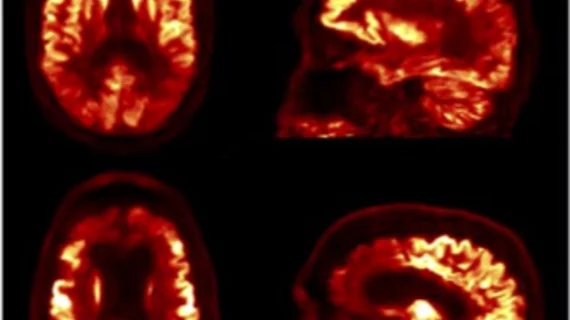
Researchers—led by Kevin Chen, PhD, a postdoctoral fellow at Harvard University's Microrobotics Lab—have found that spatiotemporally correlated data acquired using a single magnetic resonance (MR) sequence may be successfully used in a PET/MRI scanner for PET attenuation, motion and partial effects corrections.
A study of more than 15,000 childhood cancer survivors found a “surprisingly” high number lacked concern for their well-being in adulthood—despite the group’s increased health risks. Some 40 percent were unconcerned about developing new cancers.
Authors of a June 26 editorial in Annals of Internal Medicine advocated for a standard definition of "overdiagnosis" regarding cancer screenings, arguing poor understanding of the term is a threat that exposes patients to unnecessary treatments.
Photo courtesy of the Radiological Society of North America
A new study found ultra-high strength MRI may release toxic mercury from silver fillings, though commonly used 1.5 Tesla MRI machines appear to have no effect on the cavity-prone.
Irene Tracey, PhD and director of Oxford University's Nuffield Department of Clinical Neurosciences, is known as the "Queen of Pain," according to an editorial published in the July 2 issue of The New Yorker.
A deep-learning software that can automatically calculate left ventricular ejection fraction (LVEF) with less variability than a cardiologist recently received approval from the U.S. Food and Drug Administration (FDA).
The U.K.'s public healthcare system, NHS England, has fewer doctors, nurses, hospital beds and CT and MRI scanners than 18 comparable countries, according to a June 25 article in The Guardian.