To date, research pertaining to reactive lymphadenopathy has focused mostly on patients with cancer who are routinely staged and monitored via PET/CT or in women undergoing breast cancer screening and/or imaging with mammography and ultrasound.
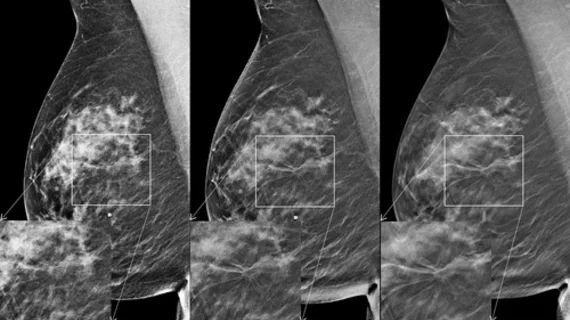
An example of architectural distortion in a 3D DBT mammogram, which is easier to see because the radiologist can look at the breast tissue layer-by-layer.
Experts found that opting for DBT-guided biopsy of suspicious breast calcifications could shave up to five minutes off the total procedure time.
In an effort to perhaps dissuade skepticism among medical students who are on the fence about the future of radiologists, experts in the field recently offered a detailed overview of the use of AI in imaging.